Streak-free skylight washing in Johns Creek, GA
Johns Creek sits in the trees. The subdivisions off Medlock Bridge and State Bridge went up through the 1990s under a heavy hardwood canopy, and a lot of those homes carry skylights over a great room or a stair landing. Shade plus the humidity coming off the Chattahoochee corridor is exactly what a skylight does not want. Angled glass that stays damp and dim grows an organic film, a green haze fed by sap, leaf litter, and river-valley moisture that rain only makes worse. We wash those skylights inside and out, reach them safely off an established Johns Creek roof, and clear the film so the daylight comes back into the room.

Skylights under the Johns Creek tree canopy
Johns Creek became a city in 2006, but most of its neighborhoods are older than the incorporation. The streets in St. Ives, Rivermont, and the subdivisions along Medlock Bridge and Abbotts Bridge Road filled in through the 1990s, and they filled in under trees. Tall oaks, poplars, and pines close over the rooflines, which is part of what makes the area feel the way it does. It is also rough on a skylight. Where a home in the open gets sun that dries the glass between rains, a skylight tucked under the Johns Creek canopy sits shaded and damp for long stretches, and shade plus moisture is the recipe for organic growth. Add the leaf litter and sap that hardwoods drop straight onto an upward-facing pane, and you get skylights that film over faster here than almost anywhere we work. Homeowners rarely see it happen, because the glass is fifteen to twenty-five feet overhead and no one is up there looking. They notice the room has gone dim, or that the skylight reads green from the floor, and by then the buildup has had a couple of seasons to settle in. That is the point we usually get the call, and it is a clean fix once we can safely reach the glass.

Organic film and Chattahoochee humidity
The film on a Johns Creek skylight is usually more organic than dusty, and that changes how it comes off. The Chattahoochee runs along the south edge of the city, and the moisture that hangs in the river corridor keeps shaded glass damp well after a rain has passed. Any surface that stays wet and out of the sun grows a thin algae layer, and a low skylight under hardwoods is close to a perfect host. Green haze is the visible part. Beneath it, sap and pollen bind into a sticky base coat that a garden hose only smears, while decomposing leaf matter in the corner of the curb holds moisture against the seal. None of it answers to rain, because the damp is half of what feeds it. It takes an actual wash, the right solution, and a squeegee or pure-water rinse to release the layer and leave the pane clear. Left alone, the growth does more than dull the light. It creeps from the glass onto the shingles around the frame, it packs the upslope edge of the curb where standing water starts leaks, and it works slowly into the seal. A skylight left dirty for years can cut the daylight reaching the room well below what the builder ever intended, which undoes the whole reason it was cut into the ceiling.

Working an established Medlock Bridge roof
Reaching the outside of a skylight is the part that keeps homeowners on the ground, and rightly so. We size up the roof before the first step. The gentle slopes we walk, staying wide of the skylight curb and the flashing that seals the opening, and the steep architectural pitches common on the two-story homes off Medlock Bridge we handle another way, either from a ladder tied off at the eave or with water-fed poles that clean the glass from the ground without anyone leaving it. A lot of Johns Creek roofs are shaded and hold morning dew late, which makes footing worse than the pitch alone suggests, so we plan around that too. We are insured, and we treat a slick, mossy north-facing slope as exactly the hazard it is instead of something to muscle through. The reach gear covers the rest. Extension ladders, roof-access equipment, and long water-fed poles between them get to almost any skylight in a Johns Creek home, high great-room panes included. What we will not do is improvise a shortcut over a hard floor or a wet roof to save fifteen minutes. The work is worth doing right, and on a roof that mostly means patience and the correct setup for whatever is actually up there.
Both panes, because half a job shows
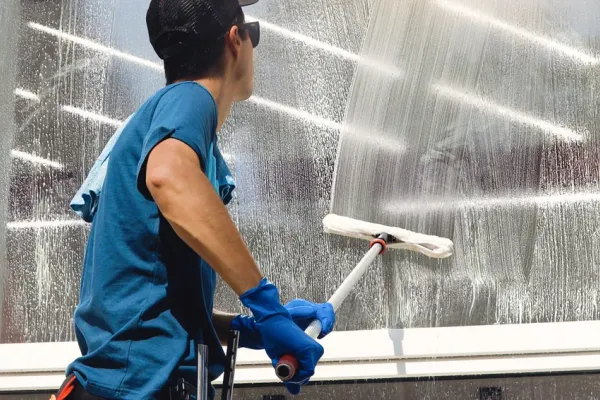
Clean the outside of a skylight and leave the inside, and the room tells on you. A fair amount of the cloudiness lives on the interior pane, where it builds unseen for years. Dust rides the heating and cooling currents up to the highest glass in the house and settles. Condensation on cool mornings dries to a film. In a kitchen skylight, a thin cooking grease drifts up and glazes the inside. Because the pane sits at the top of a vault, nobody wipes it, so it just gathers. We clean the interior side with extension poles and glass tools, or an interior ladder where the ceiling gives a safe stance, and we lay drop cloths over the floor and anything below before we start. Doing both faces is what turns a skylight from a gray rectangle back into an opening to the sky, and around Johns Creek the change is stark because the exterior film here runs heavy. While we work the inside up close, we check the well for trouble: a water stain spreading on the drywall, fog caught between the panes, a fine crack in the glazing. Those are cheap to note now and costly to discover later, so we point them out either way, no upsell attached.

One flat $35 per skylight, added to the visit
Skylights cost the least when they ride along with the rest of the glass. Folded into a whole-home window cleaning, each one is a flat $35, because the crew, the ladders, and the drop cloths are already at your Johns Creek home and there is no second trip to charge for. Most homeowners here time it with a spring or fall cleaning, which puts the skylight work right after pollen season or once the canopy drops its leaves, the two moments the glass needs it most. Each visit runs off a $175 minimum, and skylights count toward that total next to the window washing. To round out the pricing, standard panes run $8 to $12 each, glass with hard water spotting is $25, and the skylight rate stays $35 no matter how high it hangs. Homes on a standing schedule take 5, 10, or 15 percent off the whole visit, scaled to how often we come back. Setting it up is simple. Tell us how many skylights when you book, or run the numbers yourself in the online estimate tool, and you get a confirmed figure before we start. We do not invent line items from the roof, and the count you give us is the count we quote.

Skylight and window cleaning in Johns Creek
Skylight cleaning is part of our full window cleaning in Johns Creek. Read about our general skylight cleaning service, or see the same service in Cumming and Alpharetta.
Skylight cleaning questions from Johns Creek homeowners
What Johns Creek families ask before booking skylight service.
Do the skylights in older Johns Creek homes need special care?
Often, yes. Plenty of Johns Creek homes from the 1990s carry acrylic dome skylights, which scratch easily and cloud for good if someone hits them with an abrasive pad or an ammonia spray. Those get a soft wash and nothing harsh. Newer low-E coated glass needs a light hand too, so the heat-managing coating is not scrubbed away. We work out what you have before choosing a tool or a solution, which is the step a bottle of household glass cleaner skips.
How much is skylight cleaning in Johns Creek?
Skylights are $35 each when added to a window cleaning visit, which is how most Johns Creek homeowners handle them. No extra trip fee applies, since the crew and ladders are already on site, and a $175 visit minimum stands with the skylights counting toward it. For a skylight-only call we quote from the count and the roof access, and you have that number before we book the date.
What is the green haze on my skylights?
That green is an algae film, and it is common on shaded Johns Creek skylights because of the tree canopy and the humidity off the Chattahoochee. Any glass that stays damp and out of the sun grows it, and rain feeds it rather than clearing it. A real wash releases the layer and the pane comes back clear. If instead the cloudiness sits sealed between two panes, that is a broken seal, not surface film, and no cleaning fixes it, so we will tell you.
Can you clean skylights on a steep or shaded roof?
Yes. We read the pitch and the surface first. Walkable slopes we take on foot, and steep, wet, or shaded roofs we work from tied-off ladders or with water-fed poles from the ground so no weight goes onto a slick surface. Many Johns Creek roofs sit under trees and hold dew late into the morning, and we plan the approach around that. We are insured and would rather pole a pane from below than push our luck on a mossy slope.
When is the best time to clean skylights here?
Spring and fall are the natural windows. Spring clears the pollen and the winter algae, and fall handles the leaf litter and sap the canopy drops. Skylights deep under hardwoods do best on a twice-a-year rhythm, since the shade keeps the organic film coming back. The simplest approach is to attach them to a seasonal window cleaning so they never drift off the calendar.
Clear the Film Off Your Johns Creek Skylights
Shaded, green-tinged skylights steal the daylight your rooms were built for. Call (470) 333-2525 or email Alexusbestcompany@gmail.com for a free skylight cleaning estimate in Johns Creek. Insured, careful on roofs, and serving North Fulton since 2009.