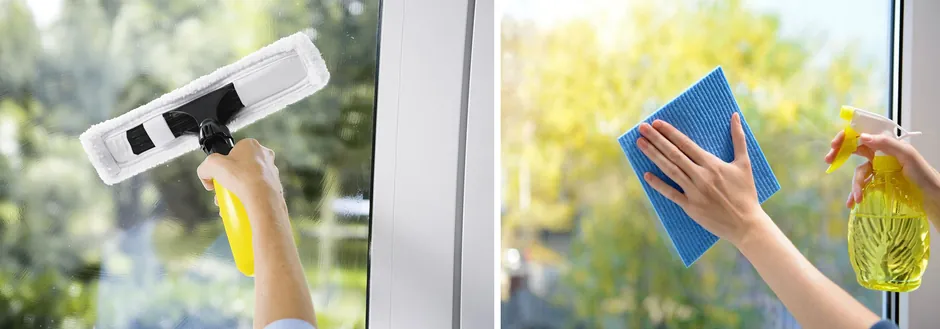
Every spring, the north metro Atlanta area turns yellow. From our home base in Cumming out through Forsyth County and across the wider Atlanta metro, cars, porches, and windows pick up that fine chartreuse film that gets into everything. Homeowners call us in the thick of it wanting clean glass, and the honest answer is usually the same: hold off a couple of weeks and you will get far more for your money. Timing a window cleaning around pollen season is the difference between glass that stays clear for months and glass that fogs back over in three days.
This is a question of when, not whether. Windows do need cleaning after pollen season, and the film left behind is worse for glass than most people think. The trick is knowing the local pollen calendar well enough to clean at the right moment.
What Atlanta’s pollen film really is
The heavy yellow coating everyone notices is mostly pine pollen. Pine grains are large and visible, which is why they blanket every surface, but they are actually low on the list of allergy triggers. The pollen that makes people miserable, from oak, birch, sweetgum, and grasses, is smaller and mostly invisible. For window cleaning, though, the visible pine layer is what matters, because it is the stuff that films over glass and clings to screens.
Pine pollen is not just dust that blows away. It is slightly sticky and, once it gets damp from spring rain or morning dew, it bonds to any film already on the glass. Wash a window in the middle of a heavy pollen week and the wet glass becomes a magnet for the next wave. Within a day or two you are looking at the same haze you started with. That is the core reason cleaning during peak pollen is mostly wasted effort and money.
The north Atlanta pollen calendar
Pollen season in the Atlanta area is not one single event. It arrives in waves, and the visible pine wave is the one that governs window timing. Here is the rough shape of it in a typical year for Forsyth County and the north metro:
| Window of time | What the air is doing | What to do about your windows |
|---|---|---|
| Late February | Tree pollen begins, counts start climbing | Too early to clean exteriors, plan ahead |
| Early to mid March | Pine and oak ramp up, first yellow dusting | Wait, the heavy film has not peaked |
| Mid March to mid April | Peak yellow pine film coats everything | Do not clean exteriors, it will re-coat in days |
| Late April | Pine film fades, counts drop off | Exterior cleaning becomes worthwhile |
| Early May | Air clears, occasional grass pollen | Best window for a full exterior clean |
The exact dates shift a little each year with the weather. A warm, early spring can pull the pine wave forward into early March, while a cold snap can push it later. The pattern holds, though: a hard yellow month somewhere in the March-to-April band, then a clear stretch once the pines finish.
Why late April and early May is the sweet spot
Once the pine trees finish releasing, the yellow film stops replenishing. The last coating washes off with spring rain, and the air goes back to normal. Clean your exterior glass in that window, roughly late April into early May, and the work actually lasts. There is no fresh pollen wave waiting to undo it, so the glass can stay clear through early summer instead of clouding over within the week.
Cleaning in this window has a second payoff. The pine film that built up over March and April does not just sit there looking bad. Combined with spring rain and warm sun, it can bake onto the glass and, on screens, trap moisture that speeds up wear. Getting it off in early May clears the whole season’s buildup in one pass, before summer heat sets it further. If you also deal with sprinkler spotting, early May is a smart time to fold in hard water stain removal before irrigation season ramps up.
Waiting until after the pines finish is also easier on your wallet. A single well-timed clean does the job that two poorly timed cleans could not. Our window cleaning cost guide walks through the per-window pricing, and the short version is that one clean at the right time beats paying twice to fight the pollen wave.
Interior and exterior windows follow different clocks
Here is the piece most people miss: pollen is an outdoor problem, so interior and exterior glass do not need cleaning on the same schedule.
Your interior glass never touches pine pollen unless you leave windows open. That means the inside faces can be cleaned any time, including during peak pollen season, without any of the re-coating trouble that plagues exteriors. A lot of homeowners do exactly that. They book interior cleaning in March or April while the outdoors is still yellow, then bring us back in early May for the exteriors once the film has passed. It spreads the work out and keeps the whole house looking sharp through spring.
Exterior glass is the part that has to wait for the pollen to finish. Screens deserve their own mention here, because they are the hidden culprit behind windows that will not stay clean. Screens hold pollen like a filter, and every rain washes that trapped pollen straight back down onto the glass below. Cleaning the glass but skipping the screens during pollen season almost guarantees a fast re-coat. When we do a spring exterior clean, screens come out, get washed on a flat surface, and go back only once they are dry.
What the leftover film does if you wait too long
Some homeowners figure the pollen will rinse off in the summer rain, so they skip the spring clean entirely. It does not quite work that way, and the film that stays behind causes a few real problems through the rest of the year.
Pine pollen that bakes onto glass across warm April afternoons does not fully wash away. It leaves a thin organic haze that dulls the pane and gives the next round of dust and sprinkler spray something to grab onto. By midsummer, windows that never got their spring clean look permanently cloudy, and they take more scrubbing to bring back than they would have with one well-timed clean in early May.
Screens take the worst of it. A screen that spent all of March and April filtering pollen holds a packed layer of it, and that layer traps moisture against the mesh. Over a season that speeds up how fast the frame corrodes and the mesh sags, which is how a $5 screen cleaning turns into a $49 rescreen down the road. Pulling and washing the screens in spring is about the cheapest insurance there is.
There is a hard water angle too. Once summer irrigation kicks in, sprinkler overspray starts leaving mineral deposits on the lower windows, and those deposits set faster over a surface that already carries a pollen film. Clearing the glass in early May gives the summer a clean starting point. If spotting has already taken hold, our guide to hard water stain removal covers what it takes to get it off, since a normal wash will not.
How to tell the pine wave is actually over
You do not need an app or a pollen count to read this. The signs are all around you in the north metro. When your car stops turning yellow overnight, when a rinsed deck stays clean for more than a day, and when the pollen no longer collects in little drifts along the curb and the driveway, the pines have finished for the year.
The trees themselves give it away. Once the pine catkins have dropped and the yellow haze stops rising off the treeline on a breezy afternoon, the heavy release is done. There is usually a final spring rain that washes the last of the film out of the air and off the roofs, and the week after that rain is close to ideal for an exterior clean. Grass pollen keeps going into summer, but grass pollen does not film over glass the way pine does, so it does not change the window timing.
If you are not sure, wait for two clear days in a row with no fresh yellow dusting. That gap is the signal that it is safe to book the exterior work and have it last.
A simple pollen-season plan for your home
You do not need to track daily pollen counts to get this right. A simple rhythm handles it:
- Late February to early March: do nothing outside yet, the heavy film has not arrived.
- March and April: if you want a spring refresh now, clean interior glass only, since pollen stays outdoors.
- Watch for the yellow to stop: when cars and decks stop turning yellow overnight, the pine wave is ending.
- Late April to early May: book the full exterior clean, including screens, tracks, and sills.
- Add hard water work if needed: early May, before sprinklers run all summer, is a good time to clear any mineral spotting.
- Keep a rhythm after that: a recurring plan through summer holds the glass clear and earns 5% to 15% off per visit.
That plan is built around how pollen actually behaves in the north metro, not a generic calendar. It saves you from paying to clean glass that is about to get re-coated, and it puts the real clean at the moment it will last longest.
Ready when the pollen clears
We clean windows across Cumming, Forsyth County, and the north metro Atlanta area, and spring is our busiest stretch for a reason. If you want your home first in line once the pines finish, it pays to get on the schedule before the late-April rush. You can request a free estimate online, look over the full price list, or call the Alexus Window Cleaning team at (470) 333-2525. Tell us your window count and we will build a flat, per-window quote and time the visit for right after the yellow lifts.